|


|
Sailing upwind takes concentration, quick reactions and a steady hand The golden rules are:
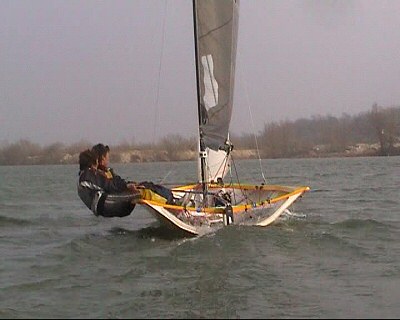
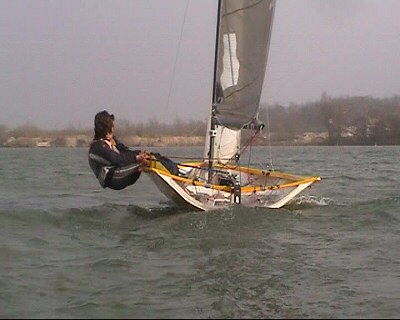
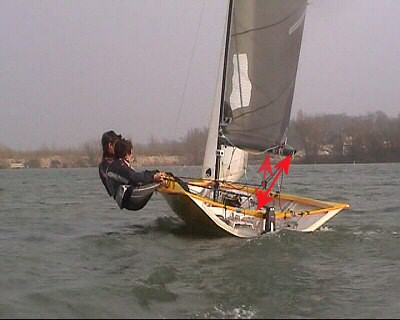
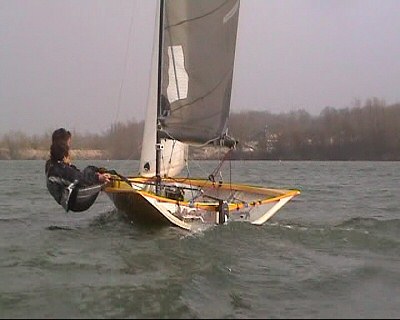
To check if the boat is flat look at the transom relative to the water. Are the edges of the deck equally high above the water? If not, you are not flat enough. If you are very keen you could invest in an inclinometer (a device which indicates your angle of heel). As the gust hits When a gust hits the boat will heel (as shown). Anticipation is key when sailing upwind. The helm and crew should be looking for other boats, wind shifts and gusts. It is often possible to spot gusts by looking out for the dark patches on the water. Whoever spots the gust should give a count down to the gust hitting so both helm and crew are prepared Shifts are more difficult to spot, but the angle of the boats upwind of you can be used as an early indicator of what is coming your way. Responding to the gust Ease the mainsheet a small amount quickly to keep the boat flat It is important to keep the boat flat because 12s have wide sides so dipping them in the water really slows you down. The only exception is in very light conditions, when a small amount of leeward heel will assist the sails to set. To get the most out of the gust
During the gust Keep the main sail eased. If the gust is prolonged then consider tightening the kicker to tension the leech and flatten the sail in order to reduce the power. As the gust dies Squeeze the mainsail back in and ease the kicker (if you pulled it on earlier) Return to your normal course
Start looking for the next gust / shift. Windward heel? Some of the top sailors like to sail with a bit of windward heel. There are a couple of theories for this;
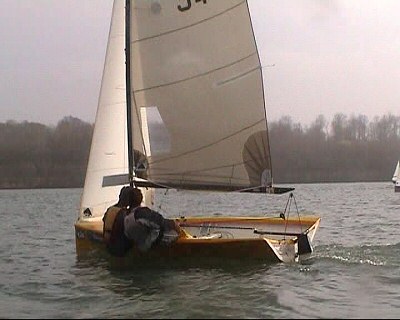
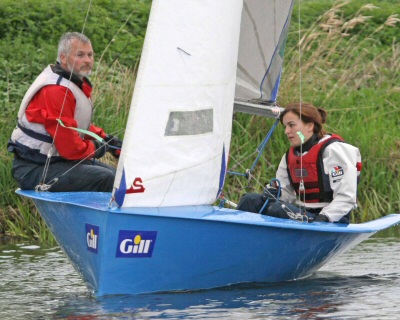
We recommend trying it for yourself and see if you like the feel. Trim in light winds In light winds the objective is to lift the transom to avoid dragging whilst also avoiding digging the nose in. You can judge whether you've got it right by looking at your stern wave. If there is turbulence then you are dragging. Sit further forwards to correct. Often the helm will be sitting close to the windward shroud and the crew will either be sitting in the middle of the boat or to leeward. (see photo) Trim in moderate to strong winds In moderate winds (as demonstrated in this picture) the crew should be sitting up against the shroud with the helm close by. You are still trying to avoid the stern dragging, but preventing nose digging starts to have more importance. As the wind increases past a force 4 the helm and crew can sit a bit further back. Often the crew and helm will be hiking at the widest point in the middle of the boat. In waves keeping the helm and crew close together is important. This means the boat can ride over the waves more easily rather than crashing into them Watch it on YouTube |
 Tacking
 Basic techniques